
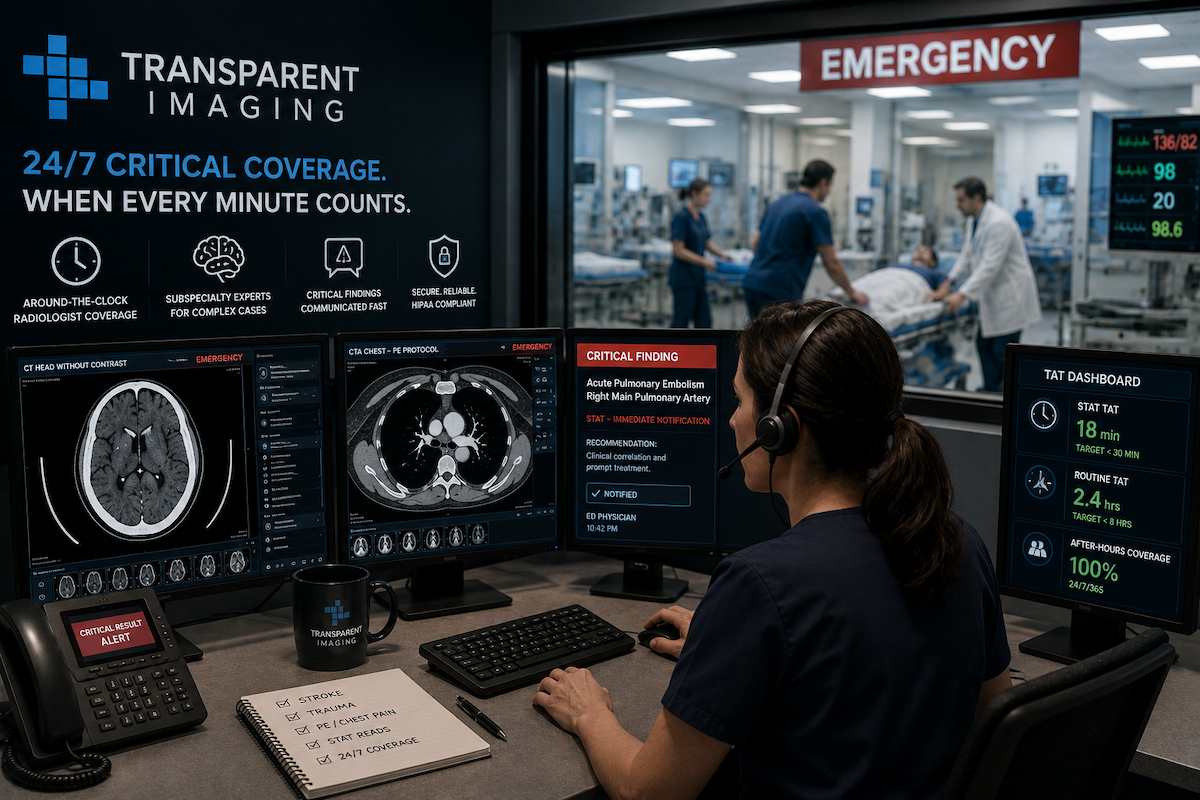
Emergencies do not keep business hours. A stroke at 3 a.m., a trauma case on a holiday weekend, a suspected pulmonary embolism on a short-staffed Sunday night: these are the moments when a fast, accurate radiology read matters most and in-house coverage is often thinnest. This guide explains how teleradiology supports emergency departments with 24/7 critical coverage, from after-hours staffing to the rapid reporting and communication that urgent cases demand. You will learn where the coverage gaps typically open, which cases are most time-sensitive, and what to look for in an emergency teleradiology partner.
This is written for hospital administrators, ED directors, trauma center leadership, and radiology department managers who are responsible for keeping urgent imaging reads moving at every hour. The aim is practical and clinically grounded, not alarmist.
Emergency teleradiology is the remote interpretation of urgent imaging studies, transmitted from the point of acquisition to a radiologist who may be located elsewhere. It grew out of the need to provide radiology coverage during odd hours, and the "nighthawk" model that emerged to deliver overnight reads to hospitals across time zones.
Emergency radiology has become a distinct subspecialty in its own right, requiring a specialized skill set to make timely, accurate diagnoses in acutely ill or injured patients. Teleradiology lets a hospital tap that expertise without staffing a full radiology team on site at every hour.
Teleradiology services commonly provide either preliminary or final interpretations. Preliminary reads are frequently used in emergency settings to support immediate clinical decisions and often include direct communication of critical findings to the treating physician. Final reads are definitive, become part of the official patient record, and typically draw on prior imaging and clinical data. An emergency department may rely on preliminary reads overnight with final interpretation completed afterward, depending on the coverage arrangement.
The core problem is a timing mismatch. Many hospitals experience their highest emergency volumes during evenings and weekends, which is often exactly when in-house radiology staffing is thinnest. CT, MRI, and ultrasound are central to diagnosing trauma, stroke, abdominal pain, chest pain, and many other urgent presentations, and a delay in interpretation directly delays the clinical decision that follows.
This pressure is compounded by a broader structural reality. Imaging volumes and study complexity have grown faster than the radiologist workforce, producing a demand-supply mismatch that is most pronounced during after-hours windows. Emergency physicians are generally not trained to interpret CT and MRI studies definitively, so the read has to come from a radiologist, around the clock. For smaller and rural facilities that may have only one local radiologist, sustaining 24/7 coverage in-house is especially difficult.
The vulnerable windows are predictable, which is what makes them manageable:
Some presentations are defined by how quickly imaging needs to be interpreted and acted upon. Emergency teleradiology coverage is built around exactly these:
The common thread is that the imaging read sits directly on the path to treatment. The faster and more reliable the interpretation, the sooner the care team can act.
A fast read is only useful if it reaches the right clinician. Communication of critical and unexpected findings is a recognized patient-safety priority, and guidance from the American College of Radiology and related bodies calls for clear communication policies that include escalation instructions for when a referring clinician cannot be reached, applied around the clock.
For an emergency teleradiology partner, this means more than returning a report. It means a defined workflow for urgent findings: who is contacted, how quickly, through what channel, and what happens when the first attempt fails. When evaluating a partner, examine the critical-findings process as closely as the turnaround time, because in emergency care the two are inseparable.
Here is how emergency teleradiology translates into operational support, step by step:
It is worth being measured about what this delivers. Research comparing night coverage models, including a Level I trauma center study published in the Journal of the American College of Surgeons in 2022, has found differences in discrepancy rates and turnaround between coverage approaches, and concluded that combining interpreters can be optimal when an in-house attending is not available. The takeaway is not that any single model is flawless, but that reliable after-hours coverage with strong quality processes is what protects patients.
When you are evaluating emergency coverage, focus on the factors that actually determine performance at 3 a.m.:
Sustaining true 24/7 coverage is fundamentally a staffing problem. A small group cannot reliably cover nights, weekends, holidays, and surges without burning out or letting the queue back up. Depth is what makes consistency possible.
Transparent Imaging is structured for exactly this. With a radiologist-led team of 200+ radiologists providing subspecialty reads, the group can support around-the-clock emergency coverage with the bench needed to handle overnight and weekend demand, route complex cases to subspecialists, and maintain the critical-findings communication that urgent care requires. The honest framing matters: the value is reliable capacity and clear workflows, not a promise that every read lands in a fixed number of minutes.
Emergency departments need radiology reads at every hour, and the hardest windows to cover, nights, weekends, holidays, and surges, are predictable. The cases that drive the urgency, stroke, trauma, intracranial hemorrhage, and pulmonary embolism, are precisely those where a prompt, accurate read supports prompt treatment. Teleradiology extends coverage into those gaps, adds subspecialty depth, and, when paired with a strong critical-findings workflow, helps ensure urgent results reach the treating clinician.
If after-hours and surge coverage is a recurring strain at your facility, a sensible next step is to map where your gaps actually fall and what your time-critical protocols require. A radiologist-led partner like Transparent Imaging can provide the staffing depth and subspecialty expertise to support reliable emergency coverage. Reach out to discuss how emergency teleradiology could strengthen 24/7 coverage at your organization.
Emergency teleradiology is the remote interpretation of urgent imaging studies by radiologists who may be located off site. It is commonly used to provide after-hours coverage during nights, weekends, and holidays, and to deliver timely preliminary reads that support immediate clinical decisions in the emergency department, often including direct communication of critical findings.
Teleradiology provides 24/7 coverage by using a pool of remote radiologists to read studies whenever they arrive, including overnight and weekend hours when in-house staffing is limited. A partner with a deep radiologist bench can sustain around-the-clock availability and absorb surges that a small on-call team could not handle alone.
Time-critical cases include acute stroke, major trauma, intracranial hemorrhage, and pulmonary embolism. In each, imaging interpretation sits directly on the path to treatment, so prompt and accurate reads support prompt clinical decisions. These are the presentations emergency teleradiology coverage is designed to support.
A fast read only helps if it reaches the treating clinician. Communication of critical findings is a recognized patient-safety priority, and ACR-related guidance calls for clear policies with escalation steps for when a clinician cannot be reached, applied around the clock. A strong emergency partner has a defined workflow for delivering urgent results, not just for producing the report.
Look for genuine around-the-clock staffing depth, documented turnaround expectations for time-critical protocols, subspecialty coverage for complex cases, a clear 24/7 critical-findings communication policy, formal peer review, proper licensure and credentialing, and secure technology that integrates with your workflow. Staffing depth is what makes consistent after-hours coverage realistic.