
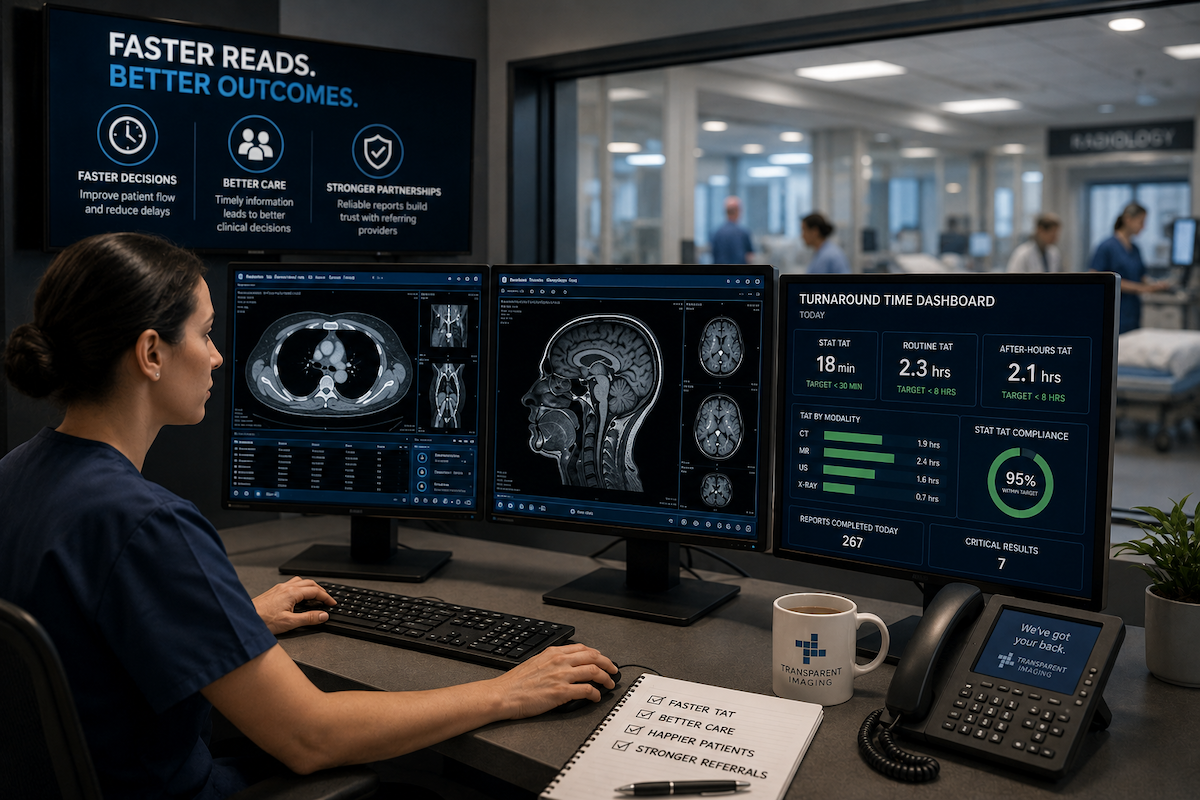
A radiology report is rarely the end of a process. More often it is the trigger for the next decision: whether to admit, discharge, operate, or send a patient home. When that report is delayed, every downstream step waits with it. This guide explains why radiology turnaround time matters for patient care and operational performance, and how teleradiology can help healthcare organizations move reads through the system more reliably. You will see what the evidence says about turnaround time, where the bottlenecks usually sit, and what practical steps leaders can take.
This is written for imaging center operators, hospital executives, emergency department leaders, and referring providers who feel the consequences of slow reads firsthand. The language here is deliberately measured. No teleradiology model can guarantee a specific read time, but the operational levers are real and worth understanding.
Radiology turnaround time is the elapsed time between a defined start point, such as image acquisition or order completion, and a defined end point, usually the finalized radiology report. Many organizations also track intermediate intervals, including the time from order to image and from image-available to preliminary or final report.
The reason TAT gets so much attention is that it sits on the critical path of patient care. A clinician often cannot act until the report is back. The faster and more predictable that report is, the faster the next decision can follow.
There is no single universal definition, which is part of the challenge. Common measurement windows include order-to-report, exam-to-report, and image-available-to-final-report. What matters operationally is that an organization defines its intervals consistently, measures them, and tracks them by priority level so that STAT and routine work are evaluated against appropriate expectations.
The case for faster reads is not about speed for its own sake. It is about the clinical and operational consequences of delay.
A study by Cournane and colleagues, published in Clinical Radiology in 2016, evaluated more than 25,000 imaging investigations for emergency medical admissions. The researchers found that radiology imaging delays were independent predictors of longer hospital length of stay, even after adjusting for illness severity, comorbidity, and other patient factors. In plain terms, slower imaging was associated with patients staying in the hospital longer, regardless of how sick they were.
The emergency department is where these dynamics are sharpest. Emergency medicine literature consistently identifies radiology turnaround time as a contributor to ED crowding and length of stay, and modeling has shown that reducing radiology turnaround time can improve ED patient throughput and reduce patient waiting time. When reads come back faster, dispositions happen sooner, beds free up, and the department can absorb the next wave of patients.
Delayed reads create a chain of secondary effects worth naming explicitly:
Not every study should be held to the same clock. A sensible turnaround time program distinguishes between priority levels and staffs to meet each one.
The practical point is to match the target to the clinical urgency, measure performance against it, and identify where the gaps are.
Improving TAT starts with knowing where time is actually lost. Common bottlenecks include:
Some of these are internal process problems best solved with workflow improvements such as Lean methods, which have been shown to reduce ED radiology process times. Others, particularly coverage and surge capacity, are where an outside partner can add the most value.
Teleradiology addresses the capacity and coverage bottlenecks directly. A teleradiology partner with a large radiologist bench can read studies during overnight and weekend hours, absorb volume surges that would otherwise overwhelm an in-house team, and route complex cases to the appropriate subspecialist without waiting for a specific local radiologist to be available.
Here is how that translates into operational improvement, step by step:
Transparent Imaging is built around this model. With a radiologist-led team of 200+ radiologists providing subspecialty reads, the group is structured to support consistent turnaround across STAT, routine, and after-hours work without leaning on a small group that cannot absorb surges. The honest framing matters here: the value is in added capacity and reliability, not in a promise of a fixed read time for every case.
If turnaround time is a pain point at your organization, a measured approach beats a sweeping one. Consider these next steps:
Radiology turnaround time is not a back-office metric. It is a lever on patient care, hospital throughput, and the trust of the physicians who depend on your reports. The evidence connects imaging delays to longer length of stay and to the crowding pressures that emergency departments know all too well. Faster, more reliable reads help patients move through the system, support timely discharge, and reinforce referring physician confidence.
For organizations where coverage gaps and surge volume are the real constraint, teleradiology offers a practical path to more consistent turnaround. If that describes your facility, a sensible starting point is to measure your current intervals honestly and then talk with a radiologist-led partner like Transparent Imaging about where added subspecialty capacity could close the gaps. Reach out to discuss how teleradiology could fit into your turnaround time strategy.
It depends on the priority level. Emergency department reports are commonly expected within a short window after images are available, and high-performing organizations set tight targets for time-critical protocols like stroke and trauma CT. Routine inpatient and outpatient reads are measured in hours rather than minutes. The key is setting priority-specific targets and measuring performance against them consistently.
Slow reads delay clinical decisions. Research published in Clinical Radiology found that radiology imaging delays independently predicted longer hospital length of stay, even after adjusting for how sick patients were. Faster reads support quicker dispositions in the ED, smoother discharge planning for inpatients, and better patient experience overall.
The emergency department often cannot make a disposition decision until the read is back. Imaging turnaround time is a recognized contributor to ED crowding and length of stay, and reducing it can improve patient throughput and lower waiting times. Faster reads help free beds and keep the department flowing.
Teleradiology can improve turnaround time by adding coverage and capacity, particularly during overnight, weekend, and surge periods when in-house staffing is thin. A deep radiologist bench absorbs volume that would otherwise back up the worklist and routes complex cases to subspecialists. It adds reliability and capacity rather than guaranteeing a fixed read time for every study.
Common causes include overnight and weekend coverage gaps, volume surges that exceed a fixed team's capacity, complex cases waiting for the right subspecialist, workflow and patient transport delays before the study reaches the radiologist, and communication friction in delivering results. Solutions range from internal workflow improvements to adding outside reading capacity.