
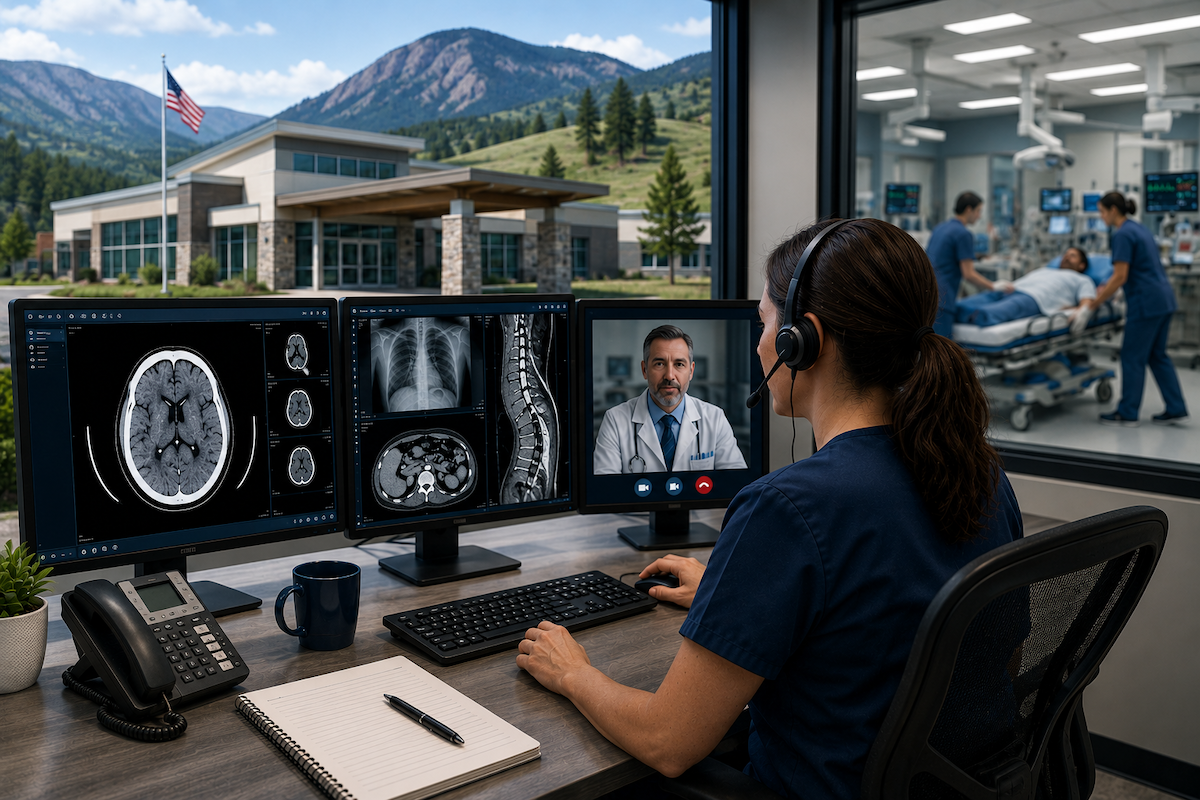
A patient in a small community hospital deserves the same quality of radiology read as a patient at a large academic center. The challenge has never been the patient or the facility. It is geography. Subspecialty radiologists are concentrated in and around population centers, and recruiting one to a rural site is genuinely hard. This guide explains how teleradiology helps rural hospitals access subspecialty expertise, closing the distance between where patients are and where specialized radiology skill happens to live. You will learn what the workforce data shows, why the gap exists, and how remote subspecialty reads work in practice.
This is written for rural hospital administrators, critical access hospital leaders, and regional health system executives who carry the responsibility of delivering strong imaging services in communities that the radiologist workforce does not naturally reach. The framing here is about access and support, not about any facility falling short.
Rural teleradiology is the remote interpretation of imaging studies performed at rural, community, or critical access hospitals by radiologists located elsewhere. The images are acquired locally, transmitted securely, and read by a radiologist who may be hundreds of miles away, including subspecialists who focus on a specific area of radiology.
The appeal is straightforward. A small hospital may not generate enough volume in any single subspecialty to justify, or successfully recruit, a full-time on-site expert. Teleradiology lets that hospital access the right expertise on a per-case basis, matching each study to a radiologist suited to read it.
It is important to name the issue accurately. Rural hospitals are not lesser facilities. The constraint is that the radiologist workforce, and especially the subspecialist workforce, is distributed unevenly across the country.
County-level research has shown how stark this can be. In one analysis, only about 41.5% of US counties had at least one Medicare-participating radiologist, and just over a fifth, roughly 21.8%, had at least one subspecialist radiologist. Counties with a local radiologist tended to have larger populations, lower rural percentages, and higher household incomes. In other words, the further a community sits from a population center, the less likely it is to have a local radiologist, and far less likely to have a local subspecialist.
The researchers also noted something important for policy: even geographic redistribution of the existing workforce may not produce enough subspecialists to cover every area. The supply simply is not large enough to spread evenly. That is what makes remote access, rather than relocation, such a practical answer.
The distribution problem sits inside a larger supply-and-demand story. Companion studies from the Harvey L. Neiman Health Policy Institute, published in the Journal of the American College of Radiology in early 2025, projected the radiologist workforce and imaging demand through 2055.
The supply study projected that the number of radiologists would grow by about 25.7% between 2023 and 2055 if residency positions do not expand. The companion demand study projected that imaging utilization would rise by roughly 16.9% to 26.9% by 2055, depending on modality, driven largely by population growth and aging. Because supply and demand are projected to grow at comparable rates, the institute concluded that the present shortage is likely to persist over the next three decades unless deliberate steps are taken.
For rural facilities, this matters in two ways. First, a static national shortage means competition for every radiologist stays intense, which makes local recruiting no easier. Second, Neiman research has found that practices with one or more rural sites experienced higher attrition than those without, and the institute pointed to the workplace challenges of remote practice, including professional isolation, as contributing factors. The recruiting and retention math is genuinely harder in rural settings, through no fault of the communities themselves.
Teleradiology addresses the distribution problem directly, by separating where expertise lives from where the patient is. Here is how that works in practice, step by step:
The result is that a small hospital can offer subspecialty-level interpretation without having to recruit and house a specialist on site. Patients can often stay in their community for imaging rather than traveling long distances, and the local care team gets expert support when a difficult case arrives.
Through teleradiology, a community hospital can access focused expertise across areas that would be impractical to staff individually on site:
The value extends past the individual interpretation. A strong teleradiology partner can support a rural facility in ways that strengthen the whole imaging operation:
These supports matter most where local radiology resources are thin, which is precisely the rural setting.
If your facility is evaluating remote coverage, a few considerations are especially relevant for rural and critical access settings:
This is the kind of support a radiologist-led partner is built to provide. Transparent Imaging offers a team of 200+ radiologists with subspecialty expertise, peer-reviewed reads, and a workflow designed for timely reporting, which together let community and rural facilities access specialized interpretation without recruiting it on site. The aim is to extend expert support to the communities that need it, not to replace local care teams but to back them up.
The gap in rural radiology access is a matter of workforce distribution, not facility quality. Subspecialists are concentrated near population centers, the national shortage is projected to persist through 2055, and recruiting specialists to rural sites is genuinely difficult. Teleradiology offers a direct and practical response: it connects community hospitals to subspecialty expertise remotely, so patients can be imaged close to home while their studies are read by the right expert.
For rural and regional health system leaders, the useful next step is to identify where your subspecialty and after-hours gaps actually fall, then evaluate whether a teleradiology partner with real subspecialty depth could fill them. A radiologist-led group like Transparent Imaging can provide that expertise and coverage. Reach out to discuss how teleradiology could expand subspecialty access for the communities you serve.
Rural teleradiology is the remote interpretation of imaging studies performed at rural, community, or critical access hospitals by radiologists located elsewhere, including subspecialists. Images are acquired locally and transmitted securely to a radiologist who reads them remotely, letting small facilities access expertise they could not recruit on site.
The radiologist workforce, especially subspecialists, is concentrated near population centers. County-level research found that only about a fifth of US counties had a subspecialist radiologist. Rural facilities also face higher radiologist attrition and recruiting challenges, so accessing local subspecialty expertise is difficult regardless of the facility's quality.
Teleradiology separates where expertise lives from where the patient is. A community hospital performs imaging locally, transmits it securely, and has it read remotely by an appropriate radiologist or subspecialist. This lets patients stay close to home for imaging while their studies receive expert interpretation, and it gives local care teams subspecialty backup on complex cases.
According to Neiman Health Policy Institute projections published in 2025, the radiologist workforce is expected to grow by about 25.7% by 2055 if residency positions do not expand, while imaging demand is projected to rise by roughly 16.9% to 26.9%. Because these grow at comparable rates, the institute concluded the current shortage is likely to persist through 2055 without deliberate action.
Yes. Teleradiology lets a critical access hospital access subspecialty reads in areas like neuroradiology, MSK, body imaging, and nuclear medicine on a per-case basis, without recruiting and housing a full-time specialist. This is especially valuable for facilities that encounter certain complex cases only occasionally.